pendrive-vs-online-delivery
Pendrive vs Online Delivery for Wedding Photos

Pendrive vs Online Delivery for Wedding Photos
For a wedding or event, online delivery through a private gallery is the better main method. Everyone who needs the photos gets them without waiting, nothing depends on one small piece of hardware, and you can control who sees what. A pendrive still has a place as a keepsake copy of the final files. It works poorly as the only way you deliver.
This guide is for wedding photographers, studios, event organisers and the families who wait for their photos. It compares the two methods on access, speed, organisation, privacy and backup, and shows how Indian wedding delivery works in practice.
Its foreverMake Wedding Photo Delivery EasierGive guests an organized way to access curated event galleries through a single QR code, with instant uploads and AI face recognition.Visit
TL;DR
A pendrive reaches one person at a time, usually after the edit is done. An online gallery reaches the couple, both families and guests together, from any phone.
Guests rarely carry a laptop or card reader. A QR code that opens the gallery on a phone removes the need for any app or file transfer.
Under India’s data protection law, photos that identify people are personal data. Controlled access, expiry and deletion are easier online than with a drive you cannot recall.
Pendrives fail, get lost and get copied freely. A damaged disk can even become a legal problem for the photographer.
The strongest approach is an online gallery first, with a pendrive of final files as an optional extra in the package.
Table of Contents
How each method works
Pendrive vs online delivery: the differences that matter
Privacy and legal risks of each method
Backup risk: what happens when hardware fails
Cost and packaging in India
Which method suits which situation
A delivery routine that works
Where It’s Forever fits
Perspective
Try online delivery on your next event
Sources
How each method works
Pendrive delivery
You finish the edit, copy the final JPEGs (and sometimes videos) to a pendrive or hard disk, label it, and hand it over at a meeting or by courier. The couple gets a physical object they can keep in a cupboard, and it works with no internet.
That is the whole appeal. The trouble starts when more than one person wants the photos, which at an Indian wedding is nearly always.
Online delivery
You upload the photos to a gallery and share access. In the simplest form this is a shared link to a folder. In a purpose-built delivery platform it is a private, branded gallery with a QR code, password or face search. Guests open it on their phones and find their own pictures.
The quality of the experience depends on which kind of online delivery you use. A pile of links in a WhatsApp group is online, but it is not organised. A single gallery with one QR code is.
Pendrive vs online delivery: the differences that matter
Question | Pendrive | Online gallery |
|---|---|---|
Who can see the photos at once | One holder at a time | Couple, families and guests together |
When they can see them | After the full edit, once the drive is handed over | Can begin with instant uploads from the event and continue as edits are added |
What you need to open it | A laptop or a phone with an OTG cable | Any phone with a browser |
Finding your own photos | Scroll through hundreds of files | Face search or organised albums |
Sharing with relatives abroad | Courier or copy the files again | Send one link or QR code |
Control after delivery | None; copies are unlimited | Access can be set, limited or ended |
Risk of loss or damage | Single physical object | Stored online, not tied to one device |
Keepsake value | High | Needs a separate printed or downloaded copy |
Access: who actually needs the photos
At an Indian wedding the people who want photos include the couple, both sets of parents, cousins who attended the Haldi and Mehendi, friends at the Sangeet and relatives who could not travel. A pendrive serves the couple. Everyone else asks the couple to forward files, and the photographer’s work gets passed around in whatever form it ends up.
Online delivery turns this around. One gallery, one QR code printed at the venue or sent on WhatsApp, and each guest looks for themselves. The photographer is no longer the bottleneck for requests like “can you send me the group photo from the Baraat?”

Speed: when the photos arrive
A pendrive cannot exist before the edit is complete, so the wait is the full editing time plus handover. Our guide to the wedding photo delivery timeline in India explains what clients can reasonably expect and why they get anxious in the gap.
Online delivery shortens the first wait. With instant uploads straight from the camera, selected pictures can reach the gallery during the event, so guests see moments from the Baraat while the celebration is still going on. Our write-up on camera to cloud for weddings goes through how that works on the day.
Organisation and convenience
A drive holds folders. Whoever receives it has to make sense of them. A gallery can be arranged by function (Haldi, Mehendi, Sangeet, Pheras, Reception), and the couple can select pictures for their album online instead of sending a list of file numbers over messages. That album selection step is where many photographers lose days to back-and-forth.
Privacy and legal risks of each method
India’s Digital Personal Data Protection Act, 2023 sets rules for processing personal data with consent for a lawful purpose, as the text of the Act states. A compliance guide by Adv (Dr.) Prashant Mali notes that images that identify individuals count as personal data. It also explains that a photographer who only takes pictures and hands them to the couple acts as a Data Processor, while one who stores guest photos and sells prints is a Data Fiduciary. It lists fines of up to ₹250 crore for violations such as processing without consent or inadequate security.
That does not mean photographers should stop delivering. It means you should know where your files go after you hand them over.
The pendrive problem: no control once it leaves your hands
A drive cannot expire. It can be copied, lent, lost on a train or left in a shop. If it holds photos of guests and children from a private ceremony, you have no way to limit who sees them. Deleting your own copy is possible, but the drive in the client’s hands is theirs.
The loose-link problem
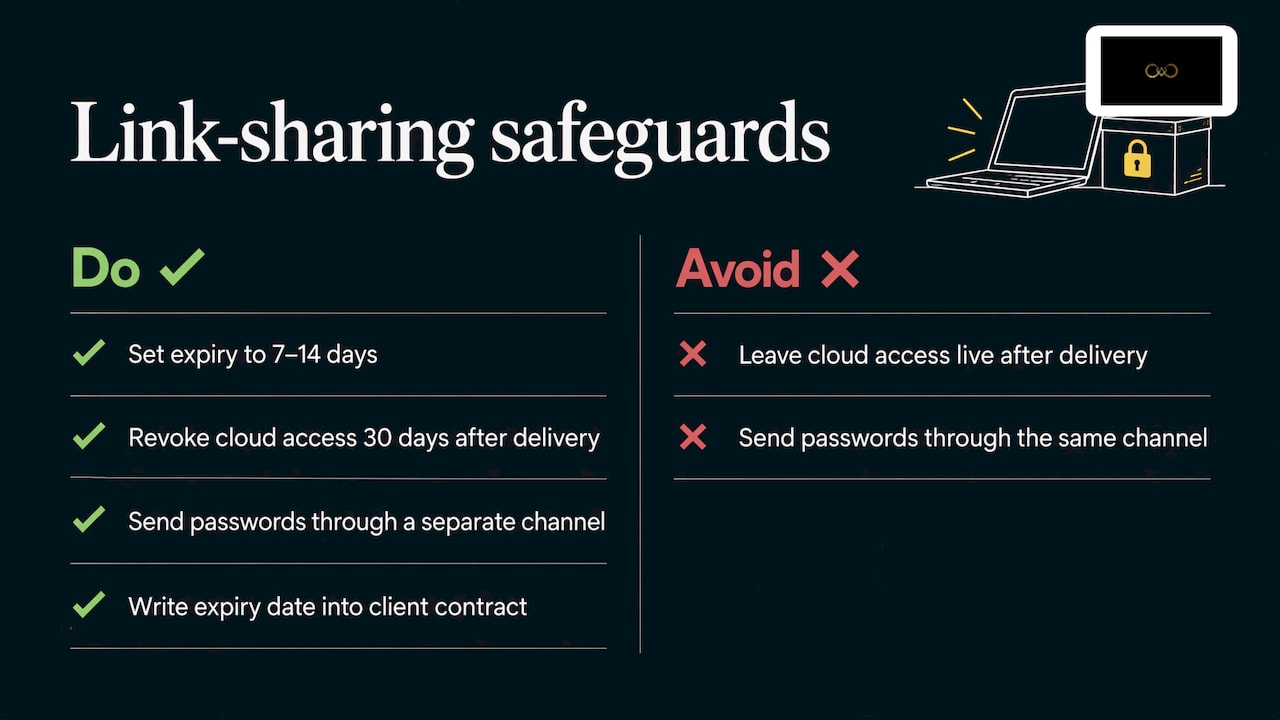
Many photographers use general-purpose file transfer links because they are quick. They differ widely in how long they stay live. A June 2026 comparison from DPDPAReady found one popular transfer service defaults to a 7-day expiry, extendable to 30 days, with no access logging, while the common cloud-folder services keep links live until someone revokes them. It recommends setting expiry to 7 to 14 days, revoking cloud access 30 days after delivery, sending passwords through a separate channel, and writing the expiry date into the client contract.
The lesson is not that online delivery is risky. It is that online delivery needs expiry, passwords and revocation to be easy. In a gallery built for this, those are settings. In a generic folder, they are chores you have to remember.
Reducing the risk, whichever method you use
The same compliance guide suggests practical habits: collect consent at the source, deliver final formats such as JPEG, organise files so they can be deleted easily, and scrub metadata such as GPS location from photos before delivery.
Two of our own guides cover the online side in detail: secure client photo sharing and private photo galleries. If you use password-based access, see our note on password protected galleries. If you are weighing face search for guests, read face recognition privacy for wedding and event photos first.
Backup risk: what happens when hardware fails
A pendrive is a single point of failure. So is the one hard disk where a photographer keeps the only copy of a wedding. According to Bhaskar’s October 2026 report, in the 2024 case Satyam Gurung v. Samden Yolmo, the West Bengal State Commission awarded ₹10 lakh in compensation after a photographer’s hard disk of wedding photos was damaged by a lightning strike. It also said professional photographers should have proper equipment and data-backup safeguards.
The practical reading for any photographer is simple. Wedding photos cannot be reshot. Keep the files in more than one place, and treat a delivery method that keeps them online and retrievable as part of your backup thinking rather than a replacement for it.
For the couple, the same logic applies. A drive in a cupboard is one copy. A gallery they can open from their phone years later is another.
Cost and packaging in India
Many Indian packages already bundle both. For example, Namdev Studio in Hisar lists, as of October 2026, a ₹30,000 Essential package with 400+ edited photos, an online gallery and all photos on a pen drive, and a ₹45,000 Classic package with 800+ edited photos, an online gallery, and all photos and videos on a pen drive. Clients clearly expect both an online gallery and a physical copy.
That shapes how you should think about cost:
Pendrive: a small hardware cost per wedding, plus the time to copy, label, pack and hand over or courier it. Prices vary by capacity and brand, so check current listings when you budget.
Online delivery: a cost for storage and for how long the gallery stays live. With pay-as-you-go pricing, you pay for the storage volume and event duration you actually use, instead of holding a yearly plan across a slow season.
The real cost of loose delivery is rarely the hardware. It is the hours lost answering “please send me my photos” from forty guests, and the lost chance to be recommended to those same forty guests.
Which method suits which situation
Wedding with many guests and functions
Online first. Multiple functions, many relatives and a group of friends who all want their own photos is exactly where a single QR code and face search save the photographer hours. See our wedding photo sharing guide for Indian weddings.
Small family event or pre-wedding shoot
Online is still easier, but a pendrive with the final files makes a pleasant handover. Offer both and let the client choose.
Corporate events and organisers
Organisers need attendees to find their own photos without handling files. A branded gallery with QR access fits better than distributing drives to an audience.
Clients with poor internet at home
A drive of final files covers this. It is the one case where a physical copy is genuinely the main deliverable, and it sits well alongside the gallery.
A delivery routine that works
Agree on delivery in the contract. State what the client gets: gallery access, how long it stays live, and whether a pendrive of final files is included.
Get consent early. Tell the couple and, where relevant, guests that photos will be shared in a gallery and how face search works.
Upload as you shoot. Send selects during the event so guests see photos while they still care about them.
Organise by function. One gallery, clear albums, branded with your studio name.
Share one QR code. Print it on a card at the venue or send it in the family WhatsApp group.
Let the client select for the album online. It replaces long message threads of file numbers.
Hand over the final copy. Provide a pendrive or download of final JPEGs if the package includes one.
Set the end date. Decide when access ends and tell the client in advance.
Where It’s Forever fits
It’s Forever Studio is event photo delivery software built for photographers, with Indian weddings in mind. It supports instant uploads directly from the camera, QR code access for guests without any app, AI face recognition tuned for Indian wedding lighting and group shots, branded galleries, online album selection, and privacy controls that let hosts manage guest and client data. Photographers pay for storage volume and event duration, with no fixed plans or yearly subscriptions, after a free trial.
The QR code photo sharing page shows how guests reach a gallery from one code, and face recognition photo sharing for weddings shows how they find their own pictures. WhatsApp-integrated lead generation for wedding photographers turns guests who like what they see into enquiries for your next booking.
Perspective
We built It’s Forever because we kept seeing the same problem described by photographers: the work is done, the photos are beautiful, and then delivery turns into a mess of links, drives and repeated requests.
Our view is simple. The pendrive solved a real problem once, when the only way to give someone a large set of photos was to hand them an object. At a wedding today, the people who want photos are in many cities and every one of them is holding a phone. So delivery should start from the phone.
That is why we focus on instant uploads from the camera, a single QR code for guests, face recognition tuned for the lighting and crowded group frames of Indian weddings, and a gallery that carries the photographer’s own branding. Guests find their photos without installing anything, the couple selects their album online, and the photographer keeps control of who sees what.
We think a gallery should be the first thing you deliver and a pendrive the keepsake you may add. The gallery is also where referrals begin, because every guest who enjoys finding their photos is a possible future client.
Gowtham
Try online delivery on your next event
If you shoot weddings and still send drives and loose links, run one event through a single branded gallery and see how many fewer messages you get afterwards. It’s Forever Studio has a free trial, and you can start at studio.itsforever.in.

After the trial, you pay for the storage and event duration you use, which suits a wedding calendar that rises and falls with the season.
FAQ
Is a pendrive still worth giving to wedding clients?
Yes, as a keepsake copy of the final files. Many Indian packages already include one next to an online gallery. It works best as an addition to online delivery, not as the only way clients and guests receive photos.
How do guests get their photos without a pendrive?
They scan a QR code at the venue or from a message, open the gallery in their phone browser, and find their pictures. With face recognition, they can look for themselves instead of scrolling through every file. No app is needed.
Is online photo delivery safe under Indian law?
It can be, if you handle consent, access and deletion properly. Photos that identify people are personal data under the DPDP Act, so use passwords or private galleries, set an end date for access, and record consent. For specific legal questions about your contracts, speak to a lawyer.
What if the client’s internet is slow?
Give them a download of the final JPEGs, or a pendrive if your package includes one, in addition to the gallery. The gallery remains the fastest way to share with the wider family.
How long should a gallery stay available?
Decide this before the wedding and write it into the contract. A fixed period with a clear end date is easier to explain and easier to manage than links that never close.
Sources
Photographers require DPDPA Law Compliance and Consent Forms
Encrypted media delivery under DPDPA: transfer-link comparison (DPDPAReady, June 2026)
What are consumer rights in case of wedding photography? (Bhaskar)
Recommended
Deliver photos to every guest — instantly.
Forever handles instant delivery, QR sharing, and face recognition — all in one place. Try it free.
Start for free →