low-light-face-recognition
Low Light Face Recognition: Getting Reliable Matches at Night Events

Low Light Face Recognition: Getting Reliable Matches at Night Events
Low light makes face recognition harder because dim, uneven lighting hides the details a system uses to tell one face from another. The fix has two parts: shoot so that faces are readable, and use face recognition built for the conditions of Indian weddings, with their mixed lamps, stage lights and crowded Sangeet floors. It’s Forever Studio’s AI face recognition is tuned for Indian wedding lighting, so guests can find their own photos from one QR code, even when the hall is dim.
This guide explains what goes wrong in low light, what the research measured, and what you can do on the day to protect your matches.
Its foreverstudio.itsforever.inFind Wedding Photos More EasilyIts Forever Studio combines AI face recognition tuned for Indian wedding lighting with QR access, helping guests find their photos without an app.Visit
TL;DR
Low light lowers brightness and contrast and adds noise, so a face has fewer usable details for a system to compare.
Side lighting and uneven light are often more damaging than darkness alone, and both are common at Haldi, Mehendi and Sangeet venues.
Research on dark images shows large gaps between well lit and dim conditions, which is why tuning for the real venue matters.
Sharp, correctly exposed faces help matching more than any later fix, so a few shooting habits go a long way.
It’s Forever offers AI face recognition tuned for Indian wedding lighting, with QR access for guests who have no app.
Table of Contents
Why dim light is hard for face recognition
What the numbers say about dark images
Three ways the field handles light
What this means at an Indian wedding
How to shoot so faces stay matchable
Why guests prefer matching by face
A short checklist for the night before a big event
Promo: face recognition built for your venues
Sources
Why dim light is hard for face recognition
A face recognition system works in steps. A 2020 survey in PMC describes three: detecting and locating the face, extracting a set of features from it, and comparing those features with a stored set. Changes in lighting can stop the very first step from working properly.

It helps to know the difference between two terms. Detection only finds that a face is present and where it is. Recognition goes further and works out whose face it is. A primer from UMass Amherst explains that detection says nothing about who someone is. In a wedding gallery, both must succeed for a guest to see their photos.
In low light, researchers describe reduced brightness and compressed contrast, which confuse feature extraction. Poor illumination also brings noise that damages the structure of the image, and the light can vary greatly within a single frame. That last point matters for weddings. A bride lit by a stage spotlight may stand next to a relative in shadow, in the same photo.
Side light and shadows do more harm than you expect
A study from the US National Institute of Standards and Technology (NIST) found that side lighting strongly degrades the performance of recognition algorithms. The researchers explained that side light adds both strong shadows and strong asymmetry to a face.
Think of a Mehendi evening with a single lamp to one side, or a Baraat lit by street lights and portable LEDs. The problem is not only how dark the scene is, but where the light falls on the face.
A broader academic review from 2015 found that lighting changes within a face image affect classification error more than the difference between the people in a database. In plain words, the light can matter more than who is in the picture. That is why a system tuned to real venue conditions is worth more than one tested only in clean, even light.
What the numbers say about dark images
Research gives a useful picture of how much lighting matters.
What was measured | Result | Source |
|---|---|---|
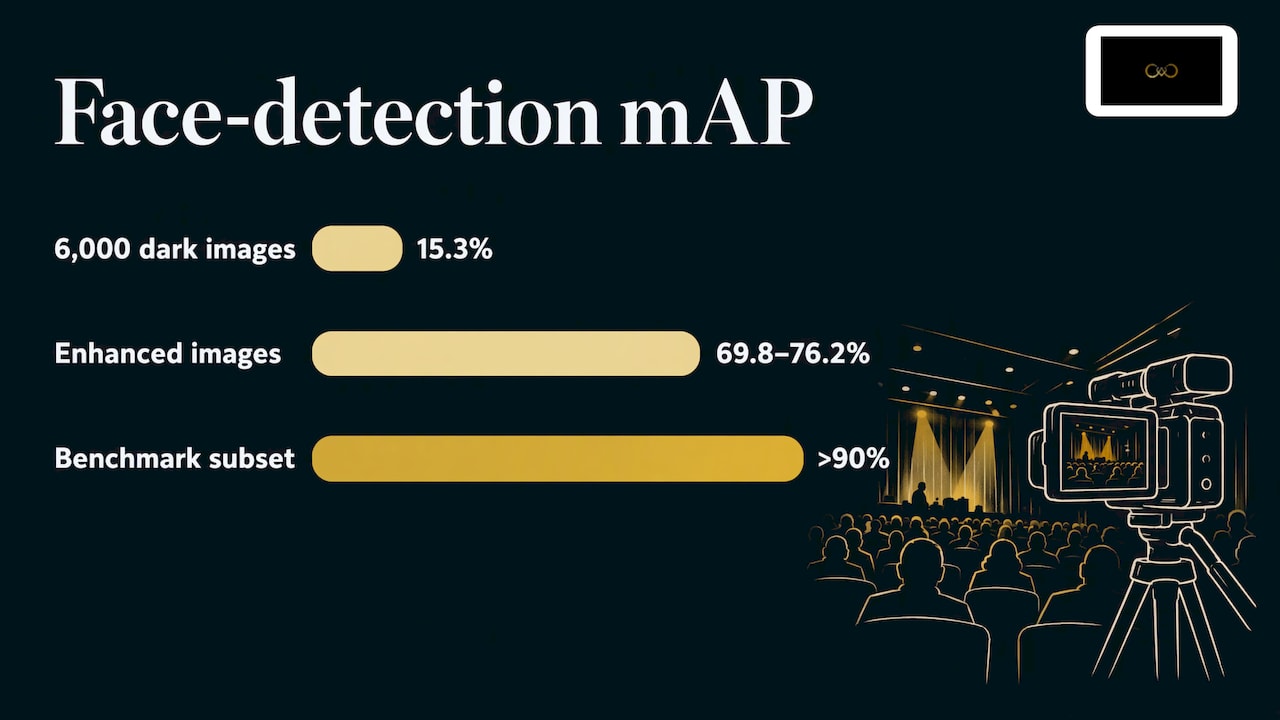
A leading face detector on 6,000 real low-light images (DARK FACE) | 15.3% mAP, against above 90% on the hard subset of a standard benchmark | |
Detection after image enhancement on the same type of data | 69.8% to 76.2% mAP, depending on the enhancement method | |
Identification accuracy after rejecting poor-quality probe images | From 60.67% to 69.00% for one method, and from 92.33% to 94.67% for another |
mAP is a score for how well a detector finds faces, where higher is better. The first row shows how steeply a general-purpose detector can fall in the dark. The second shows that preparing the image for the detector lifts results a great deal. The third shows that image quality at the start decides much of what follows.
The takeaway for photographers is practical. Lighting is the largest variable you do not fully control, so the system you choose should be built around it, and the photos you feed it should be as readable as you can make them.
Three ways the field handles light
If you are curious how researchers approach the problem, three ideas come up again and again.
Brighten the image first. A 2024 IEEE paper, Low-FaceNet, brightens dark images while keeping the face details recognition needs. Its authors note that simply re-lighting a face may not help recognition, which is why they link the two steps.
Handle uneven light region by region. Because light varies across a frame, one enhancement setting may not suit every face. The Recurrent Exposure Generation authors point towards multi-exposure approaches for this reason.
Judge image quality before matching. The Abaza study argues for a quality measure that combines contrast, brightness, sharpness, focus and illumination.
A 2016 systematic review in Springer lists six broad strategies for light variation, from light compensation to re-illumination algorithms. The common thread is that no single trick solves it. Good results come from systems designed for the conditions where they will actually be used.
What this means at an Indian wedding
Indian weddings stack up almost every lighting challenge in one event.
Haldi: bright midday sun mixed with deep shade under a canopy.
Mehendi: warm, low lamps and fairy lights, often from one side.
Baraat: moving subjects, street lighting, colourful LEDs and heavy crowds.
Sangeet and reception: dim halls, stage spotlights, haze, and dozens of faces in each frame.
Most research datasets are built in simpler settings. For instance, the Indian Classroom Face Dataset was collected in classrooms with both a DSLR and a mobile camera, and it includes samples with poor illumination, low contrast, blur and varied poses. That is a good start, but a packed Sangeet floor adds colour, crowds and movement on top.
This is where a purpose-built tool earns its place. It’s Forever’s AI face recognition is tuned for the lighting and group conditions at Indian weddings, which is the setting you actually shoot in.
How to shoot so faces stay matchable
You cannot change a hall’s lighting, but you can improve what your camera records. These habits help whatever system reads your photos afterwards.
Keep the face the brightest, sharpest part of the frame
Quality measures in the research include brightness, contrast, sharpness and focus. All four are in your hands. Expose for the face, not the backdrop. A face that is slightly bright but sharp is easier to read than a dark, soft one.
Watch the direction of light
Since side lighting causes the most trouble in the NIST work, turn your subject a little towards the main light source where you can. At a Mehendi with one lamp, ask the person to face it for a moment. A small turn removes much of the harsh shadow across one cheek.
Capture a few frontal, clear faces of key people
Get a handful of clean, front-facing shots of the couple and close family earlier in the day, in better light. Those become strong reference points when the same people appear in dim night frames.
Avoid heavy blur and obstructed faces where you can
Motion blur, hands over faces and heavy veils or garlands reduce detail. You will not avoid them all at a Baraat, and you do not need to. Just make sure each important person appears in several clear frames across the day.
Upload as you shoot
It’s Forever supports instant uploads straight from the camera, so photos reach the gallery while the event is still on. Guests get matches sooner, and you see early on whether a venue’s lighting needs a small adjustment from you.
If you also run group portraits, planning matters as much as settings. This guide to planning large group photos covers how to arrange big groups so that every face is visible, and the same thinking helps at family sessions after the ceremony.
Why guests prefer matching by face
Guests do not want to scroll through thousands of photos. They want their own. With face matching, a guest scans a QR code, takes a selfie and sees their photos, with no app to install. Our guides explain how AI face recognition works for event photos, how it applies to wedding photos and what accuracy means for wedding galleries.
For you as the photographer, that single QR code replaces a mess of links and files. Guests view a branded, organised gallery, and privacy controls let hosts manage guest access and album selection. The set-up is covered in our event photo QR code guide.
A short checklist for the night before a big event
Walk the venue and note where the light is warmest, dimmest and most one-sided.
Decide where you will place yourself for the main moments, so key faces get the best available light.
Agree with the family on a few early, clear portraits of the people guests are most likely to search for.
Set up your gallery and QR code so signs are ready at the entrance and on tables.
Confirm your instant upload is working before the first guest arrives.
Promo: face recognition built for your venues
If your reception halls are dim and your Sangeet floors are crowded, you need a delivery tool built around those conditions. It’s Forever Studio gives you instant uploads from the camera, AI face recognition tuned for Indian wedding lighting, QR access for guests without apps, branded galleries, online album selection, WhatsApp-integrated lead generation and privacy controls for client and guest data.

See how it works on our face recognition photo sharing page, or start from the It’s Forever Studio homepage.
Our view: light is the venue’s, readability is yours
We built It’s Forever for photographers who deliver at Indian weddings, so we think about light the way you do. A Sangeet is not a lab. The light is warm, mixed and often from one side, and guests are packed together.
The research agrees that illumination is one of the hardest variables for face recognition. That is exactly why we tune our AI face recognition for the lighting and group conditions of Indian weddings, rather than for tidy, evenly lit rooms.
We also believe the guest experience matters as much as the matching. One QR code, no app, a branded gallery with your name on it, and privacy controls so hosts decide who sees what. When guests find their photos in seconds, they share them, and referrals follow.
Shoot the way you always have, keep faces sharp, and let the delivery do the rest.
Gowtham
FAQ
Does face recognition work in a dark wedding hall?
It can, but results depend on how readable the faces are. Research shows that dim light, noise and uneven lighting make faces harder to match. A system tuned for wedding lighting, such as the AI face recognition in It’s Forever, is designed for exactly these halls.
Is face detection the same as face recognition?
No. Detection finds that a face is present and where it sits in the image. Recognition uses the face to work out which person it is. A guest gallery needs both steps to work.
What lighting is hardest for matching faces?
Strong side lighting is a major problem, according to NIST research, because it adds heavy shadows and asymmetry to a face. Single-lamp set-ups at a Mehendi or mixed lighting at a Baraat can produce this. Turning your subject slightly towards the main light helps.
Do guests need to install an app to find their photos?
No. With It’s Forever, guests reach the gallery through a single QR code without an app. You can read more in our QR code photo sharing guide for weddings.
Sources
Recurrent Exposure Generation for Low-Light Face Detection (arXiv, 2020)
Quantifying How Lighting and Focus Affect Face Recognition (NIST, NISTIR 7674)
Single-Stage Face Detection Under Extremely Low-Light Conditions (ICCV Workshops, 2021)
Design and evaluation of photometric image quality measures (IET, 2014)
Low-FaceNet: Face Recognition-Driven Low-Light Image Enhancement (IEEE, 2024)
Automatic Facial Recognition: A Systematic Review on the Light Variation (Springer, 2016)
Recommended
Deliver photos to every guest — instantly.
Forever handles instant delivery, QR sharing, and face recognition — all in one place. Try it free.
Start for free →