ai-face-recognition
AI Face Recognition for Event Photos: How It Works

AI Face Recognition for Event Photos: How It Works
AI face recognition looks at the faces in a photo, turns each one into a set of numbers, and matches those numbers against other photos. For a photographer, this means a guest can take a selfie and see only the pictures they appear in, without scrolling through 3,000 images. This guide explains how that works, where it goes wrong, and what to check on privacy before you use it for a wedding or event in India.
Itsforeverstudio.itsforever.inHelp Guests Find Their Event PhotosItsforever combines AI face recognition with instant uploads and QR codes, helping guests access curated event galleries without sorting through multiple links.Explore Itsforever Studio
TL;DR
Face recognition for events works in three steps: find faces, convert each to numbers, and group similar ones. A guest’s selfie is then matched against the gallery.
Accuracy depends on light, head pose, focus and blocked faces. Real event photos are harder than studio portraits, so test on your own work.
Face recognition is different from face detection (finding a face) and from public face search engines (searching the open web). Event tools search only the gallery you upload.
In India, faces are personal data under the DPDP Act, 2023. Consent, clear notice, security and a way to complain all matter.
Choose software on lighting performance, privacy controls, branding and how guests actually open the gallery.
Table of Contents
What AI face recognition means for event photos
How automatic face tagging works
Why wedding photos are hard for the algorithm
How guests find their photos in practice
Face recognition, face search engines and chatbots are not the same
What to check before choosing automatic photo tagging software
Privacy and consent in India
Our perspective
Putting it to work on your next event
Sources
What AI face recognition means for event photos
The phrase covers several different things, and the top search results mostly show one of them: public face search engines that look for a person across the internet. That is not what a wedding photographer needs.
Three terms are worth separating:
Face detection finds where faces are in an image. It does not know whose face it is.
Face recognition compares a face with other faces to decide whether they are likely the same person.
Online face search runs a recognition match across a very large public collection of images.
In event delivery, recognition is closed. Only the photos you uploaded to one gallery are searched, and only when a guest asks. India’s National Informatics Centre describes the same idea for government photo collections: AI-based face search lets a user find photos by uploading an image or taking a selfie, without needing names or dates. That is exactly the situation at a wedding. Nobody remembers which ceremony a photo came from, or what time it was taken.
One-to-one and one-to-many matching
Technical documentation from AWS explains that face matching can compare one face with another (1:1) or a source face with a whole collection (1:N). A guest’s selfie against your gallery is a 1:N search. The system returns a similarity score, and whoever builds the workflow sets the threshold above which a result counts as a match.
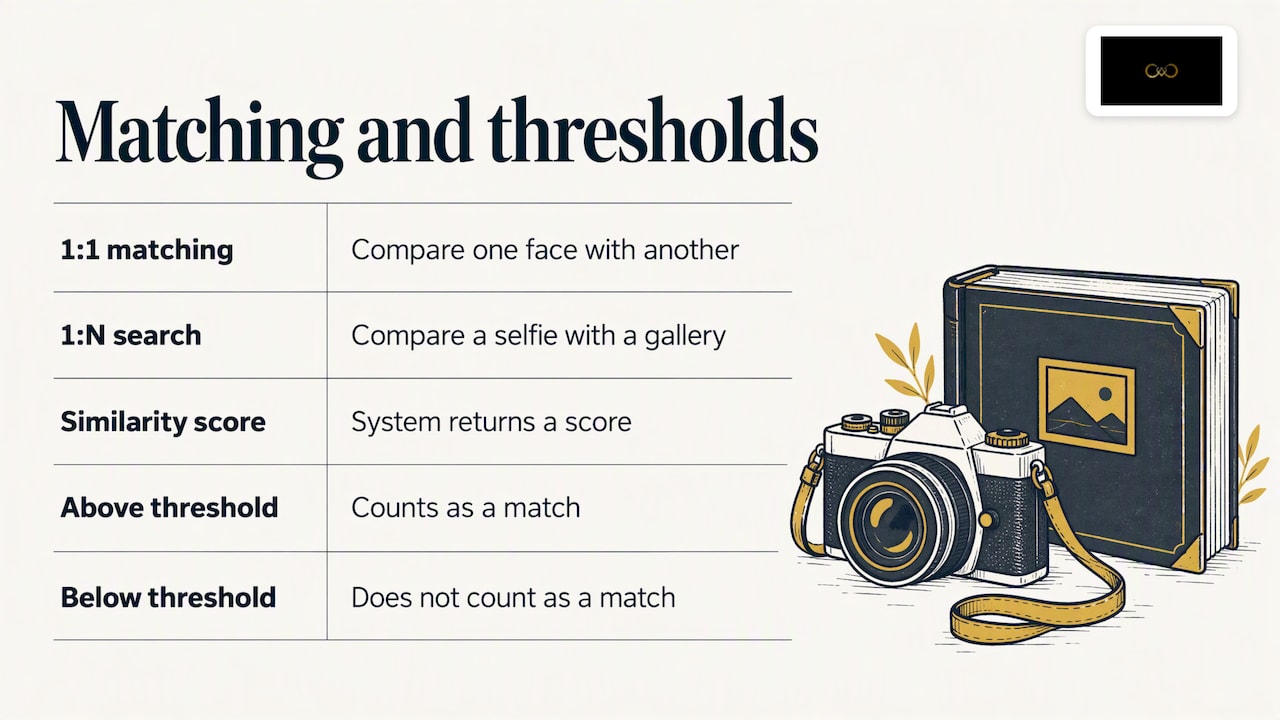
That threshold matters more than most people expect. Set it too loose and guests see strangers in their results. Set it too strict and guests miss photos they are in. Good software chooses a sensible default and lets the photographer adjust it.
How automatic face tagging works
Most photo tagging systems follow the same three stages. Public documentation from a self-hosted photo tool describes them as detection, embedding and clustering: locate the faces, turn each into a numerical vector, then group similar vectors into identities.
Detection. The software finds every face in every image, including small faces at the back of a group shot.
Embedding. Each face becomes a list of numbers that describes its features. Two photos of the same person should produce lists that are close to each other.
Clustering. Faces with very similar numbers are grouped. The same approach is behind the people groups in consumer apps: Google Photos says it detects faces, creates numerical face models to estimate similarity, and groups photos with very similar faces that are likely to be the same person.
For event delivery there is a fourth step. When a guest uploads a selfie, the system makes a numerical model of that face and looks for the nearest clusters in the gallery. The guest sees only those photos.
Tagging by name or tagging by face
Older workflows relied on someone typing names against faces. With a 400-guest wedding that never happens. Automatic tagging avoids it: the guest does the matching themselves, by looking at their own face. You do not need a guest list, and nobody has to be named.
Why wedding photos are hard for the algorithm
A studio passport photo is the easy case: frontal, even light, neutral expression. Wedding photos are the opposite. NIST’s large evaluation of identification algorithms found that accuracy is heavily influenced by image quality, lighting, head pose and occlusion, and that photos taken in unconstrained settings produce higher false negative rates than controlled portraits. A false negative here means the guest is in the photo but the system fails to show it.
Think about a typical Indian wedding day:
Haldi: faces covered in turmeric paste, squinting, people laughing with their heads turned.
Mehendi: low-angle shots, hands near faces, mixed indoor light.
Sangeet: coloured stage lights, motion, flash and dark backgrounds.
Baraat: moving crowd, dupattas and safas, sunglasses, powder and colour.
Pheras: smoke from the havan, veils and a lot of people standing close together.
AWS lists lighting, head pose, focus, resolution, occlusion, facial hair, glasses, hats, expression and makeup among the things that change recognition performance. Almost every item on that list shows up at an Indian wedding at some point, often in the same photo.
Newer models cope better, but not perfectly
The NIST report also notes that modern convolutional neural network algorithms are more tolerant of poor image quality than older ones, though human review is still needed when similarity scores are weak. Practically, this means a photographer should expect most guests to find most of their photos quickly, and a small number to be missed. A good delivery tool makes the fallback easy: guests can still browse the full gallery or event-wise albums.
Why a collection is harder than a video
Research on person recognition in photo collections points out that event photos are not a continuous video. The same person can look substantially different from one shot to the next, and applying face recognition or person re-identification directly may not work. The same paper describes models that add contextual cues, such as clothing similarity, to improve credibility. That is a useful reminder: the best results come from a system built for photo collections, not a generic face matcher dropped onto a gallery.
How guests find their photos in practice
Here is the flow guests should experience, whether you deliver the day after the event or while it is still going on:
The guest scans a QR code printed on a card, a standee or a table tent. No app is needed.
The gallery opens in the phone browser, with your studio’s branding.
The guest takes a selfie or uploads one from the camera roll.
The system matches the face and shows only the photos they appear in.
The guest views, downloads or shares the photos, and can send the couple a message.
For the photographer, the setup is smaller than it sounds. You upload from the camera or from your laptop, the software processes faces in the background, and one QR code covers every ceremony. If you want to see the mechanics, our page on face recognition photo sharing for weddings walks through the guest experience, and the QR code photo sharing page explains how access without an app works.
Why this helps more than a shared link
Without face search, a typical delivery looks like a folder link sent to the couple, who forward it to a family WhatsApp group. Guests open a gallery of thousands of images, give up after a minute and ask the couple to “send my photos separately”. The photographer then answers these requests for weeks. A selfie search removes the queue, and your name stays attached to every photo that gets shared.
Face recognition, face search engines and chatbots are not the same
People often ask whether ChatGPT can find a face, or whether any AI can search for someone online. Here is how they differ.
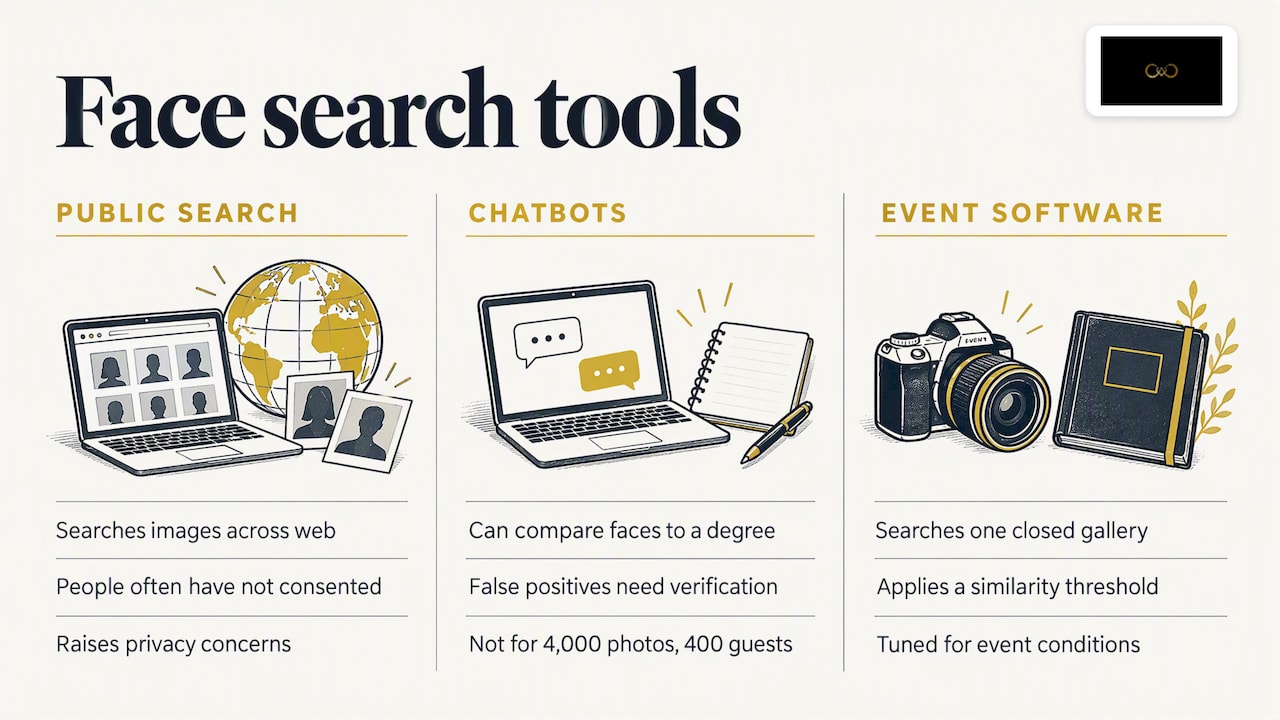
Public face search engines compare a face with images from across the web. They are built for a different job and raise real privacy questions, because the people being searched usually have not agreed to it.
General chatbots can compare faces to a degree. A study in the journal PLOS-style human comparison set found that GPT-4V performed comparably with humans on six face-matching tests but was less accurate than state-of-the-art deep convolutional neural networks. Another assessment found that ChatGPT showed face-matching ability, but that its false positives can be persuasive, so users should not rely on its answers without verification. It is not a tool for processing 4,000 wedding photos for 400 guests.
Purpose-built event software searches a single closed gallery, applies a threshold, and is tuned for event conditions. That is the category that makes sense for delivery.
Is face recognition 100% accurate?
No. NIST’s work shows accuracy improves with better algorithms and better images, but not to the point where review is unnecessary. The honest promise to a client is “most guests will find their photos in seconds”, not “every photo will be found”.
What to check before choosing automatic photo tagging software
Photographers often start with a feature list. Start with these questions instead.
Does it work in your light?
Upload a real gallery from a sangeet or a night baraat, not a demo set. Try selfies from guests wearing glasses, turbans or heavy makeup. AWS advises that workflows should test performance on their own content rather than rely on general claims. That applies to you as a buyer too.
How does the guest get in?
If guests must install an app, create an account or remember a password, most will not do it. Look for browser-based access from a QR code, a clear page in the language of your guests, and a download option that works on ordinary phones.
Who controls privacy?
The host or couple should be able to decide who can see which albums, whether guests can download, and when a gallery expires. The US Federal Trade Commission’s guidance on facial recognition recommends privacy by design, reasonable security, clear retention and disposal practices, and clear notice and choice. It is American guidance from 2012, not Indian law, but the questions it asks are the right ones for any buyer.
Is it branded as you?
A delivery experience with your logo, colours and contact details works as marketing every time a guest opens it. Check that the guest view does not carry the software company’s name above yours.
Does it help you win the next booking?
Every guest who opens a gallery is a potential client for a cousin’s wedding or an engagement. Look for ways to turn those visits into enquiries, for example a WhatsApp button inside the gallery. See how that works on our lead generation for wedding photographers page.
Can the couple still choose their album photos?
Delivery does not end with a gallery. Couples need to pick images for the printed album. Tools that include online album selection save a round of emails and screenshots.
Privacy and consent in India
A face is personal data. The Digital Personal Data Protection Act, 2023 allows processing for a lawful purpose with consent or for certain legitimate uses, and it requires consent to be free, specific, informed, unconditional and unambiguous, given by clear affirmative action. Notices must say what data is collected and why, and the organisation responsible must provide security safeguards and a way to raise grievances.
Two points matter for a photographer:
Who is responsible? The Act calls the entity that decides the purpose and means of processing a data fiduciary, and it carries the main duty to comply. Depending on how you and your software provider split decisions, you may carry some of that duty. Talk to a lawyer or a data protection professional if you are unsure how it applies to your studio.
What do the rules add? The DPDP Rules, 2025 set out obligations such as reasonable security safeguards, grievance redressal and breach notification to the Data Protection Board of India and affected individuals.
The selfie step is useful from a consent point of view. The guest chooses to submit their face to find their own photos. That is very different from software that quietly identifies every person in a gallery and exposes a name list. The FTC’s guidance says privacy concerns are sharpest when anonymous people are identified without their affirmative consent.
India’s policy think tank NITI Aayog, in its responsible AI paper, also argues for maintaining records, human review and periodic assessment of facial recognition systems. For a studio, that translates to simple habits: tell the couple that face search is used, put a line in your contract, delete galleries when the agreed period ends, and respond quickly when a guest asks for a photo to be removed.
A short checklist for your contract
State that guests can find photos by selfie, and that this is optional.
State how long the gallery stays online and who can access it.
Say that you will remove an image or a guest’s face data on request.
Keep a contact for questions about personal data.
Our perspective
We built It’s Forever around one frustration: great wedding work gets lost in the last mile. The photographer shoots for ten hours, edits for weeks, and then the delivery is a pile of links, a WhatsApp group and a dozen requests for “my photos”.
We think face recognition is only useful when it is tuned for the setting where it is used. Indian weddings have stage lights at the sangeet, outdoor glare at the baraat and large groups in every frame. That is why our AI face recognition is tuned for those conditions and not for passport-style portraits. It is also why we do not promise perfection. We want a guest to find most of their photos in seconds, and we want a clear way to browse the rest.
We also believe the photographer should stay visible. The gallery carries your branding, the guest needs no app, and the couple and host keep control of access and album selection. Privacy is part of that: the guest chooses to use a selfie, and the host decides who sees what.
Most of all, we think delivery should earn you the next booking. When a guest enjoys finding their photos, they remember who took them.
— Gowtham
Putting it to work on your next event
If you shoot weddings, a simple way to start is to run one event through face search and see what guests do. Upload the gallery, print a QR code card for the venue, and ask the couple to mention it at the reception. Then check how many guests used it and which photos were hardest to match.
It’s Forever is pay-as-you-go: you pay for the online storage and event duration you need, with no fixed plans or yearly subscriptions, and there is a free trial before you commit. You can see the full workflow, from instant uploads to branded galleries, on the It’s Forever home page, or read our longer take on why face recognition photo sharing changes events. For faster hand-over during the event itself, see instant photo delivery.
FAQ
Can AI do face recognition on wedding photos?
Yes. The software detects every face, converts each to a numerical model and groups similar faces. A guest’s selfie is then matched against those groups. Results depend on light, pose and focus, so some photos may be missed.
Is face recognition 100% accurate?
No. NIST’s evaluations show that photos taken in unconstrained settings give higher miss rates than controlled portraits. Good software handles most cases and gives guests a way to browse the full gallery when a match fails.
Can ChatGPT find a face in a set of photos?
It can compare faces to a degree, but studies found its false positives can be persuasive and that it is less accurate than dedicated deep learning systems. For a large event gallery, use software built for matching faces in collections.
Is it legal to use face recognition for event photos in India?
The DPDP Act, 2023 treats a face as personal data and requires clear, affirmative consent or another lawful ground, plus notice and security safeguards. A guest who submits their own selfie to find their photos is a clear consent step, but you should confirm your studio’s obligations with a legal professional.
Sources
Face Recognition Vendor Test (FRVT) Part 2: Identification, NIST
Facing Facts: Best Practices for Common Uses of Facial Recognition Technologies, FTC
Recommended
Deliver photos to every guest — instantly.
Forever handles instant delivery, QR sharing, and face recognition — all in one place. Try it free.
Start for free →